
You're staring at a job posting you've rewritten four times.
"Chief Marketing Officer. Full-time. Competitive salary + equity."
You haven't posted it yet. Because every time you do the math, you end up in the same place: $300K all-in for someone who won't ship anything meaningful for six months. That's a quarter of your runway on a bet that marketing will finally start working, assuming you even find the right person, assuming they don't leave in eighteen months, assuming the board doesn't ask why pipeline hasn't moved by Q3.
So you close the tab. Again.
Maybe you'll just hire another agency. Maybe you'll promote the marketing coordinator and hope for the best. Maybe you'll keep doing it yourself at 11 PM after the kids are asleep, reviewing blog drafts and wondering why none of this is translating into pipeline.
Here's what I want you to consider: the question you're asking is wrong.
"Should I hire a fractional CMO or a full-time CMO?" sounds like a hiring decision. It's not. It's a timing decision. And most founders get the timing wrong because they're optimizing for the wrong variable.
The real question isn't "which one?" It's "which one now?"
A full-time CMO is the right answer eventually. For most growth-stage companies, there's a point where you need someone embedded five days a week, building culture, managing complexity, sitting in every leadership meeting. That day will come.
But that day is probably not today.
The mistake I see over and over: founders hire for the company they want to be, not the company they are. They picture the org chart they'll need at $50M and start filling it at $5M. They hire a full-time CMO before there's a marketing function to lead, before there's a strategy to execute, before they even know which channels work.
That's not a hiring decision. That's an expensive experiment disguised as progress.
The companies that scale smarter do something different. They buy certainty before they buy commitment. They bring in senior leadership to figure out what's broken, build the foundation, and prove what works. Then they hire full-time to scale it.
That's the case for fractional. Not because it's cheaper (though it is). Because it's faster to results, lower risk, and right-sized for where you are.
What a fractional CMO does
Let me be specific, because "fractional CMO" means different things to different people.
When I step into a company as a fractional CMO, I'm not advising from the sidelines. I'm not handing over a strategy deck and disappearing. I'm operating. I own the marketing function. I make decisions. I run the team, manage the agencies, sit in leadership meetings, and am accountable for outcomes.
The difference between fractional and full-time isn't ownership. It's hours. I'm typically working 10-20 hours a week with a company, not 50. That means I'm not doing everything myself. I'm doing the strategic work, the diagnostic work, the prioritization, the leadership, and directing others to execute.
In practice, that looks like:
The first 30 days: I audit everything. What's working, what's broken, what's missing. I clarify positioning and messaging. I identify the 2-3 moves that will change the quarter, and I build a roadmap that your team can execute.
Months 2-6: I run the function. Weekly syncs with leadership. Direct management of your marketing team or contractors. Agency oversight with real KPIs. Campaign execution on the channels that matter. Dashboards the CEO can read.
The handoff: When the engagement ends, you don't have a hole. You have a playbook, a team that knows how to win, and the option to hire a full-time CMO who inherits a functioning system instead of a mess.
The goal is always to build something that outlasts me. Not to create dependency.
What a full-time CMO does
A full-time CMO is a salaried executive who owns brand, demand, team, and budget. They sit at the leadership table. They shape multi-year strategy. They hire and develop an in-house team. They build the marketing culture.
This is the right move when marketing is already a machine and needs a steward. When you have multiple products, multiple regions, multiple segments. When the org requires sustained daily leadership across layers. When you need someone to own the brand story and the culture that carries it.
The tradeoff is pace and cost.
The best full-time CMOs are worth every dollar. But they don't ramp overnight. A realistic timeline: 4-6 months to hire, 3-6 months to ramp. That's potentially a year before you see meaningful output. If you're still trying to figure out what marketing should even look like, you're asking a city planner to draft blueprints for a town that doesn't exist.
Beautiful plans. Nowhere to live.
The differences that matter
Forget the feature comparison. Here's what you should care about:
Cost (the runway math)
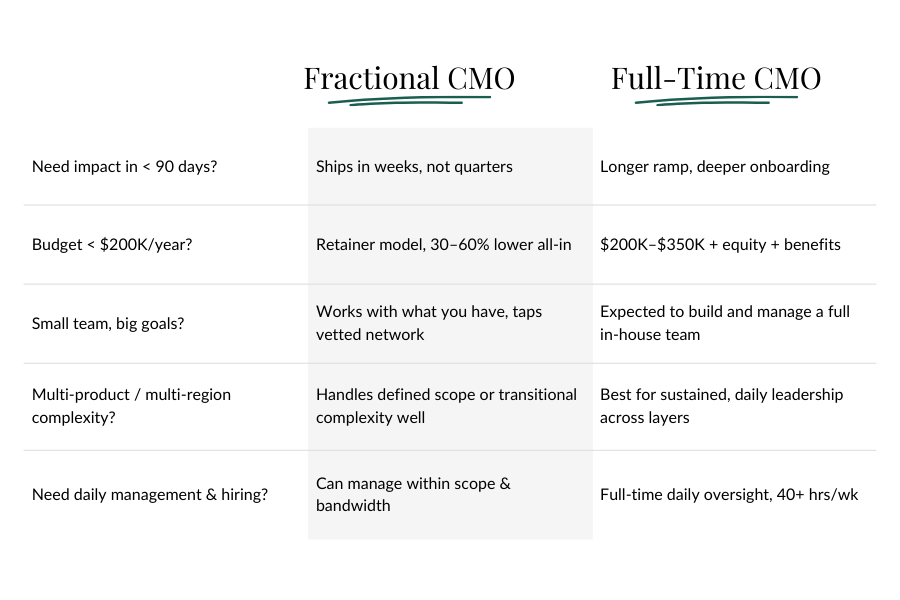
Fractional runs $5K-$20K per month depending on scope. Full-time runs $250K-$350K per year once you factor salary, bonus, benefits, equity, and payroll tax. All-in, fractional typically lands 30-60% lower.
But the real difference isn't the line item. It's the structure. Fractional pricing ties to defined outcomes within a set bandwidth. You're paying for judgment applied to specific problems, not an always-on salary. For companies managing cash carefully, that clarity matters.
Speed to impact
Fractional shows up with pattern recognition loaded. I've seen your situation before, probably multiple times. I know where to look, what to prioritize, and what to ignore. That means shipping in weeks, not quarters.
Full-time requires deeper onboarding. They need to learn your business, your team, your politics. They need to hire. They need to build relationships. All of that is valuable work. It's also slow work. If you need movement in the next 90 days, that timeline won't save you.
Flexibility
Fractional scales up or down with your needs. Need more hours for a launch? We flex. Need to pause during a cash crunch? We can structure for that. Full-time is a commitment. Equity, benefits, management overhead, and the cost of getting it wrong.
Team structure
Fractional works with the team you have. I can run 1:1s, manage agencies, hire contractors, and direct execution, all within a defined cadence. I also bring a vetted network to fill gaps fast when you don't have time to recruit.
Full-time is expected to build the org. Hire, manage, develop, scale. Daily leadership across multiple layers. If you need that, you need that. But if you're not ready for headcount, you still deserve senior leadership. Fractional lets you buy brains before bodies.
When fractional is the right call
You're fractional-ready if:
You have traction but no clear owner for marketing. The CEO is approving blog posts. The VP of Sales is managing the agency. Someone senior needs to own this, and it shouldn't be someone whose actual job is something else.
Your marketing person is good but needs leadership. You hired a marketing manager who's executing hard but can't build a strategy. They need someone above them who knows what to prioritize, not another peer.
You need to prove what works before you scale it. Big channel bets are on the table. Paid, content, outbound, events. You need someone to run focused experiments and tell you which ones deserve more fuel.
You can't wait 12 months. Pipeline is unpredictable. The board is asking questions. You need senior firepower now, not after a six-month search and a six-month ramp.
Here's what fractional does that people underestimate: it lays the runway for the full-time hire you'll eventually make. When that CMO walks in the door, they inherit systems, dashboards, positioning, a team that knows how to execute, and proof of what channels work. They're set up to win instead of starting from scratch.
What that looks like in practice:
DroneSense builds mission-critical drone software for public safety. When I started as fractional CMO, there was no marketing department. Founder-led everything. The website was outdated, content was thin, social presence was minimal.
In 90 days, we rebuilt the foundation: new site, SEO content, paid ads, sales enablement. Inbound leads tripled and stayed there. Not a temporary spike. A sustained 3x.
That's what happens when senior leadership meets execution. Not eventually. Now.
When full-time is the right call
Hire full-time when:
Marketing is already a machine. The strategy works. The channels are proven. You need someone to optimize, scale, and steward, not figure it out.
Complexity is your daily reality. Multiple products, multiple regions, multiple segments, enterprise sales cycles, global teams. This requires someone embedded in the org every day.
You need to build culture. Marketing isn't just a function; it's a team you're growing. You need a leader who can hire, develop, and retain. That takes presence.
You have the runway and the conviction. $300K+ is a real commitment. You should make it when you know exactly what you're getting and why it's worth it.
The sanity question I ask founders: Are you trying to create momentum, or manage complexity?
If it's momentum, go fractional. Build the foundation first.
If it's complexity, and it's genuinely daily complexity, go full-time.
If you're not sure, you're probably not ready for full-time.
The honest downsides of fractional
I'm not going to pretend fractional is a silver bullet. It's not.
If your biggest need is daily people leadership, deep cultural stewardship, and heavy cross-functional management, a fractional leader will feel stretched. There are only so many hours in the week. Team-building at scale is hard work, and it requires presence.
If you're ready for a full-time CMO, hire one. Fractional is here to add optionality and speed, not to dodge the investment you need.
The honest assessment: fractional is right for probably 70% of companies between $1M and $15M ARR. For the other 30%, the org complexity or growth stage genuinely requires full-time leadership. The mistake is thinking you're in the 30% when you're in the 70%.
The decision that extends your runway
The wrong hire burns runway. The right leadership extends it.
Fractional gives you senior firepower today. Full-time compounds it tomorrow. Both are real. Both are valuable. The question is sequence.
Most founders I talk to aren't choosing between two good options. They're stuck between a premature commitment and continued chaos. Fractional is the third option: get the leadership you need, prove what works, and make the full-time hire from a position of strength instead of desperation.
At Ghost Labs, I step in as your fractional CMO to move fast, build lean, and measure what matters. You get a strategy that matches your stage, momentum you can see on a dashboard, and the clarity to know when you're truly ready for the next hire.
If you're tired of random acts of marketing and ready for someone to own this, let's talk.
Frequently Asked Questions
What does a fractional CMO do?
A fractional CMO owns your marketing strategy and execution on a part-time basis. That typically includes clarifying positioning, building a growth roadmap, aligning sales and marketing, managing agencies or contractors, and running focused experiments. The scope is defined upfront. You're paying for judgment applied to specific outcomes, not an always-on presence.
How many hours does a fractional CMO work per week?
Most engagements run 10-20 hours per week, depending on scope. Enough to provide real leadership. Not enough to do every task yourself, which is why fractional CMOs direct teams rather than replace them.
What's the difference between a fractional CMO and a marketing consultant?
A consultant advises and hands off recommendations. A fractional CMO owns the work. I'm accountable for outcomes, not just opinions. I run your team, manage your vendors, and sit in your leadership meetings. Think operator, not advisor.
When should I stop using a fractional CMO and hire full-time?
When marketing is functioning predictably and your biggest need shifts from creating momentum to managing daily complexity. Multiple products, regions, or a growing internal team that needs sustained leadership. A good fractional engagement leaves the full-time hire in a much stronger position to succeed.
Is a fractional CMO worth it for an early-stage startup?
For most early-stage teams, yes. You get senior pattern recognition without the runway cost of a full executive salary. The risk of hiring full-time too early is paying for organizational leadership before the organization exists. Fractional lets you buy strategy and traction first, then scale into full-time when the timing is right.
